What the World Is Eating · Issue 2

Sardines:
Small Fish, Big World

Portugal grills them over charcoal. Spain turned the tin into an art form. Japan salts, vinegars, presses and even grinds them into soup. Sardines are humble, intensely flavored and nutritionally strange in all the right ways.

Portugal · sardinhas Spain · conservas Japan · iwashi EPA + DHA Edible bones
One food. Three kitchens. A small fish with a very large culinary map.
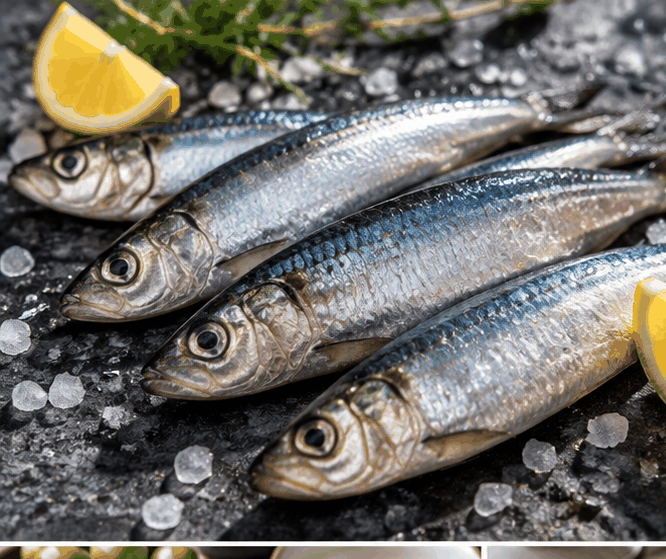
Fresh silver sardines on ice with lemon and herbs.
Fresh sardines · silver, oily, perishable

First surprise: “sardine” is not one single fish.

Sardine is a common culinary name for several small oily fish. The exact species changes with geography, regulation and market. That sounds like trivia until you discover that food law actually cares about it.

Spain's Ministry of Agriculture notes that canned products sold simply as conservas de sardinas must be made from Sardina pilchardus. If certain other sardine species are used, the product name must include the scientific species. In other words, the word on the tin carries a biological definition.

Japan complicates the story in a different direction. Iwashi is used across several familiar small schooling fish, and official regional-cuisine records include Japanese sardines as well as anchovy-like fish under local sardine traditions.

Sardines are less a single fish than a global idea: small, oily, abundant fish turned into food before they can disappear.
The nutrition story

The little-fish advantage

Sardines compress several things people usually shop for separately into one food: complete protein, the long-chain omega-3 fats EPA and DHA, calcium when the softened bones are eaten, selenium, iron, vitamin B12 and some vitamin D.

The NIH Office of Dietary Supplements lists a 3-ounce serving of canned sardines in tomato sauce at about 0.74 g DHA and 0.45 g EPA. Its calcium fact sheet lists 3 ounces of canned sardines with bones at about 325 mg calcium, roughly 25% of the current U.S. Daily Value. Sardines also appear prominently in NIH tables for selenium and vitamin D.

~1.19 gEPA + DHA in 3 oz canned sardines in tomato sauce, NIH data
325 mgcalcium in 3 oz canned sardines with bones
45 μgselenium in 3 oz canned sardines with bone
0.01 μg/gFDA mean mercury concentration for sardine
The calcium depends on eating the bones. Fresh boneless sardine fillets and boneless canned sardines are not nutritionally identical to whole canned sardines with softened bones. The bones are the reason the calcium number becomes remarkable.

This is also why sardines are useful in a food-first discussion of connective tissue and structural nutrition without pretending they are a treatment for back pain. They deliver protein, marine omega-3s and minerals in an ordinary meal.

Small fish, lower mercury

The mercury story is unusually favorable.

Sardines are on the FDA/EPA “Best Choices” list for mercury. The FDA's technical table gives sardine a mean mercury concentration around 0.01 micrograms per gram, far below large predatory fish such as swordfish or bigeye tuna.

The biology makes sense: small fish are generally lower on the food chain and do not live long enough to accumulate methylmercury the way long-lived predators can. That does not mean “zero contaminant.” It means sardines are one of the lower-mercury seafood choices in the FDA framework.

FDA categorySardine is a “Best Choice” in the current FDA/EPA fish-advice chart.
The practical lessonVariety still matters. The FDA advises eating a variety of lower-mercury fish rather than the same species every time.
The part almost nobody tells you

With fresh sardines, temperature matters more than cooking skill.

Sardines are among the fish that can form histamine when they are mishandled after the catch. Bacteria can convert naturally occurring amino acids in the fish muscle into histamine when the fish spends too much time warm.

The FDA's 2024 guidance is especially blunt about this: once histamine has formed, washing, freezing and cooking do not remove it. Prevention is about rapid chilling and maintaining good time-temperature control.

That is not a reason to fear sardines. Properly harvested and properly handled fish have little to no detectable histamine. It is simply another reason fresh sardines should smell clean, stay cold and be purchased from a source that treats them like the perishable fish they are.

Fresh sardines are not supposed to smell aggressively “fishy.” Strong decomposition odors are not a culinary personality trait.

One food · Three kitchens

Three places that built completely different traditions around the same little fish

Portugal gives sardines smoke and bread. Spain gives them preservation and patience. Japan turns them into festival food with salt, vinegar, ginger and rice.

🇵🇹
Portugal · Sardinhas assadas

Charcoal, bread and summer streets

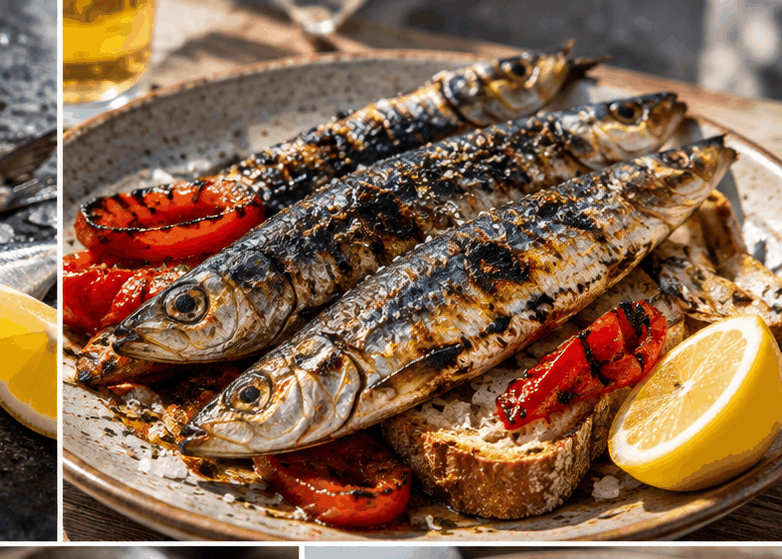
Portuguese-style grilled whole sardines with roasted red peppers, bread and lemon.
Portugal: sardinhas assadas, charred whole and eaten simply with bread, peppers, olive oil and summer smoke.

Portugal's tourism authority describes grilled sardines as traditional throughout the country and especially tied to Lisbon's Popular Saints festivities in June. During those celebrations, sardines are eaten on bread and commonly accompanied by grilled peppers.

There is almost no culinary camouflage here. Whole fish, high heat, smoke, coarse salt and bread. The fat in the sardine protects the flesh over the fire while the skin chars and crisps.

Try the idea: whole grilled sardines + rustic bread + roasted peppers + lemon or olive oil.
🇪🇸
Spain · Conservas

The tin became part of the cuisine

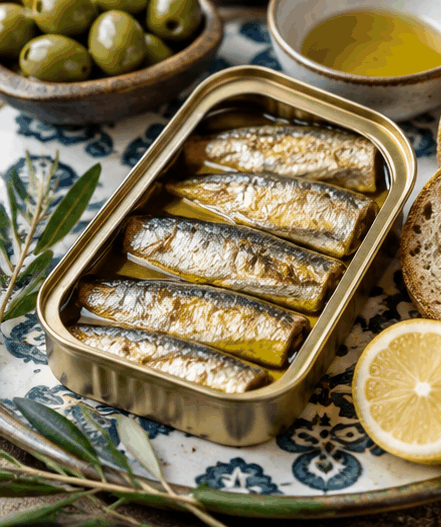
Spanish-style sardines packed in olive oil beside olives, bread and lemon.
Spain: sardines preserved in oil, where the tin is pantry culture rather than emergency food.

Spain has both fresh sardine traditions and an enormous preservation culture. Galicia's tourism materials describe the region's long history of salting and canning fish, with sardines among its major preserved seafoods.

Spain's Ministry of Agriculture describes the modern oil-packed process in detail: the fish are washed, sorted, cleaned, cooked, packed with salt and oil, sealed and sterilized. The result is shelf-stable, tender and very different from a fresh grilled sardine.

This is one of the reasons a good tin can feel less like “backup food” and more like a finished ingredient.

Try the idea: sardines in olive oil + good bread + lemon + olives + sliced tomato.
🇯🇵
Japan · Iwashi-zushi

Salt, vinegar, ginger and pressed rice

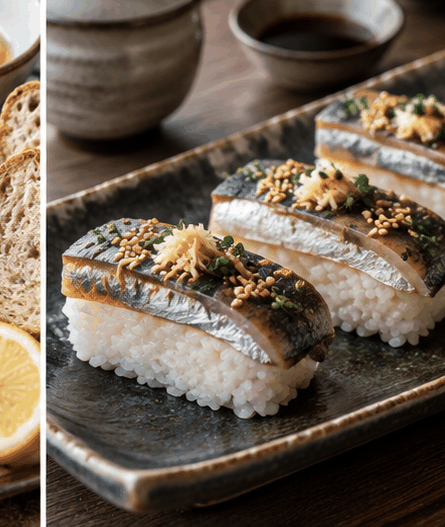
Japanese-style sardine sushi with vinegared rice, ginger, sesame and herbs.
Japan: iwashi-zushi, where sardines are salted, vinegared and pressed with seasoned rice.

Japan's Ministry of Agriculture documents iwashi-zushi as a regional food in Mie Prefecture, traditionally prepared for autumn festivals and gatherings.

The fish are cleaned, salted, then marinated in vinegar. Vinegared rice is seasoned with ginger and sesame, then pressed together with the sardine. It is preservation, seasoning and celebration in the same technique.

Japan also has sardine dumpling soups, dried sardines, pickled sardines and sardine-based fish sauces. The fish is not one dish there. It is an entire category of possibilities.

Try the idea: vinegared sardine + seasoned rice + ginger + sesame, pressed or formed like sushi.

How to buy a tin without overthinking it

There is no single “correct” sardine. Different tins are genuinely different foods.

Want the calcium?Choose whole sardines with the softened bones still present.
Want less sodium?Compare labels. Salt levels vary substantially between brands and sauces.
Oil or water?Oil gives richer texture and carries flavor; water keeps the fish leaner. Neither automatically makes the fish “good” or “bad.”
Skin on?Skin is edible. Removing it is a texture preference, not a requirement.
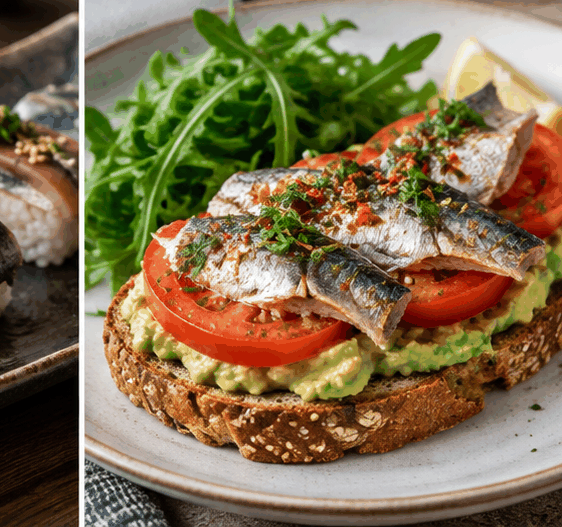
Sardine, avocado and tomato toast with arugula, lemon and herbs.
Stephen's easiest version: sardines over avocado and tomato toast with lemon and arugula.
Stephen's easiest way to try them

Sardine, Avocado & Tomato Toast

This is not supposed to imitate Lisbon, Galicia or Mie. It is the simplest Food for Back Pain version: one tin, real food around it, enough acidity to cut the richness, and no complicated cooking.

  • 1 slice sturdy whole-grain bread
  • 1/2 ripe avocado
  • 1 ripe tomato
  • 1 small tin sardines
  • Fresh lemon
  • Arugula + herbs + black pepper

Make it

Toast the bread until genuinely crisp. Sardines need structure underneath them.
Mash avocado over the toast and add thick tomato slices.
Lay the sardines over the top. Keep the soft bones if they are present and you want the calcium.
Finish with lemon, arugula, herbs and black pepper. Taste before adding salt because the sardines may already bring plenty.
What to notice Fat + acid + crunch. The avocado softens the sardine's intensity, tomato keeps it juicy, and lemon makes the fish taste cleaner rather than heavier.

Why sardines are such a good “world food”

They are cheap in one place and delicacy in another. They can be street food, pantry food, festival food or sushi. They can be grilled over open flame or sealed in a tin for years.

And nutritionally, they reward eating the whole animal. The skin is edible. The bones can be edible. The oily flesh carries EPA and DHA. Very little has to be discarded.

Maybe sardines never needed a rebrand. Maybe we just forgot that the rest of the world already knew what to do with them.

Next in What the World Is Eating

Buckwheat

Japan. Eastern Europe. France. One seed that became noodles, porridge and crêpes without actually being wheat.